
Wikis
In high school not many of my teachers used wiki-style programs or websites. In fact, only my Ancient History class used Blackboard. I found it extremely helpful in posting homework answers, answering open discussion questions and emailing the teacher questions. Since young people usually spend time online, it is clever to incorporate an online database for answers and discussion. Nonetheless, I can see how it would be a problem as students could easily copy their answers from the internet or other students who have already posted their work. If students write down their answers and bring them into class, like usual, teachers would trust them because they can see that it is their own work. I did not mind using Blackboard for just that one class because I like to write, rather that type, my homework. I also prefer synchronous communications, such as instant messaging, as someone can help you straight away. However I do not mind using asynchronous communications, like email, if I do not need answer right away. At university, I found discussion boards are useful in seeing other people's opinions and resources are well categorised. I think that wikis may be more effective for larger groups of people, such as a university environment rather than a high school classroom.
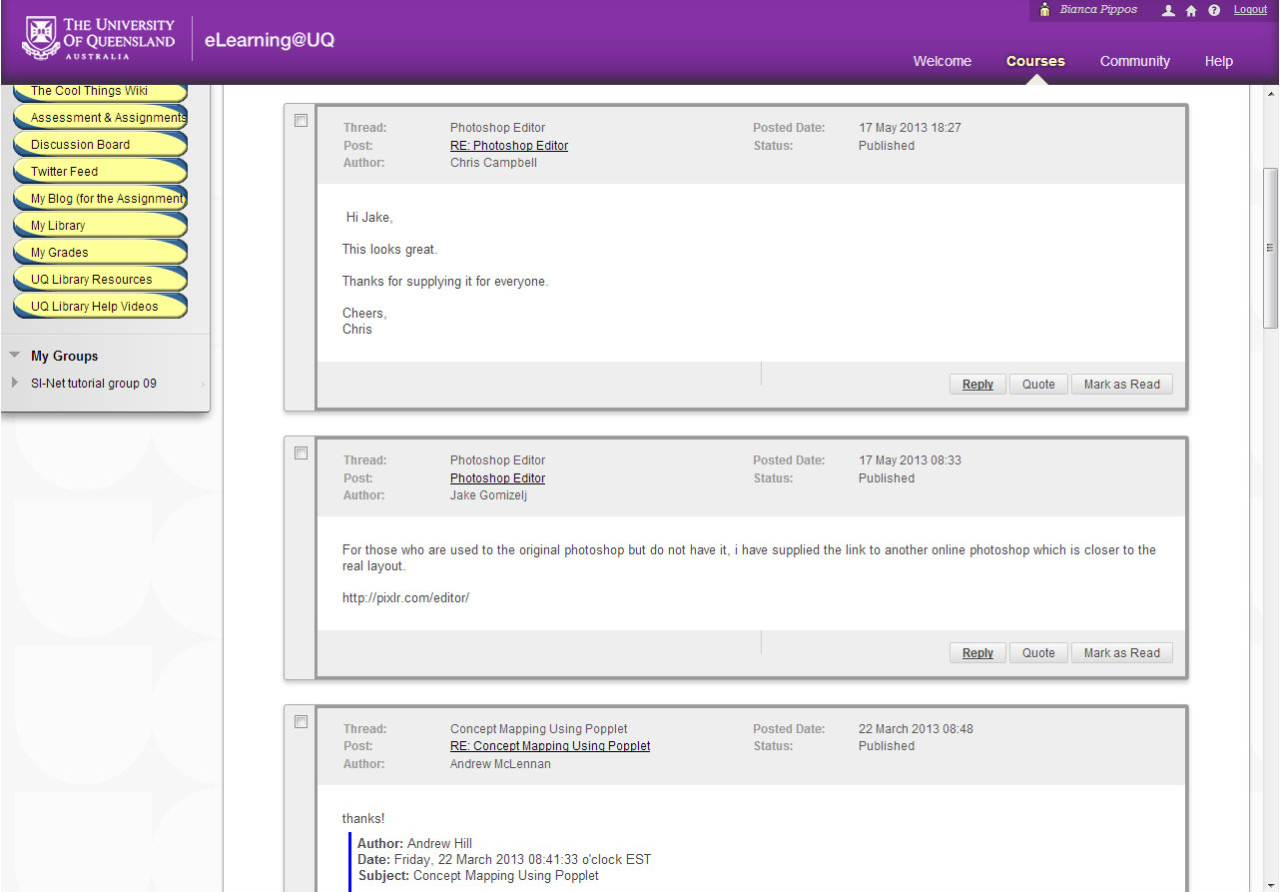
An example of the discussion board from the UQ website.
Wikis, as a relatively new form of classroom technology, are essentially online classrooms. Students can do anything that happens in a classroom. They can make a post, send homework or questions to the teacher, email, work on group assignments or find documents they need for class. Everything a student needs is all in the one place. The authors of Transforming Learning with New Technologies, wrote that, "Teacher and classroom websites,... discussion boards, blogs, and wikis are the major components of any communication system you might create as a teacher." (Maloy, R. W., Verock-O'Loughlin, R., Edwards, S.A., & Woolf, B.P., 2011, p. 210). Similar to the reasons that smart devices and laptops are useful, wikis can be accessed anytime and anywhere. The problem with wikis is that students can easily copy work from websites. Students could also copy off students who have already posted their answers to the page. Yet this can be argued that this issue would happen in a classroom anyway. Just like a normal classroom, teachers need to make sure that students are creating their own work. Guidelines would need to be devised in order for the wikis to be used to their full potential. The writers of Wikis believe that, "Wikis might also prove to be an ideal vehicle for soliciting ongoing input for research or projects..." (Wikis, 2005). The problem I see with assessment incorporated with wikis is that it would be hard to observe which student or students are putting in more work. Since all the work is done via the web, there is no actual way to tell who developed what information. This is why, for assessment, students should not use wikis but rather collaborate ideas face to face. Discussion and brainstorming ideas would be more effective and easier confrontationally. Personally, I think that wikis would be better for homework research, asking questions and emailing only.
